



The Judgement Room
The Future of L&D · Melbourne CBD · Friday 18 September 2026

Knowledge got cheap.Judgement didn’t.

One afternoon. Five leaders representing banking, defence, higher education and human-centred AI. One question every learning function is now quietly asking: what is our job when the machine already knows the answer? If you weren’t in the room, this is the closest you’ll get.

60Minutes on stage
5Panellists
4Sectors in one room
1Book launched
A note before you read on

We didn’t record the panel. On purpose.

Put a Head of Learning from one of Australia’s largest banks, an Army Colonel, a Deputy Vice-Chancellor and two of the country’s sharpest thinkers on learning and AI on the same stage, and you want them to say what they actually think. Cameras change that. So we kept the panel itself off the record.

What we can share is the shape of the conversation: the questions that silenced the room, the arguments that landed, and the ideas people were still debating in the foyer an hour later.

We’ve reconstructed them below, with our own take on what each one means for anyone responsible for how people learn.

Who was on stage

Five lenses on one question.

What is the future of L&D when AI can produce knowledge on demand? Each panellist came at it from a different world, and that was the point.

Damien Woods

Damien Woods

Head of Learning & Growth, Westpac

Chair · Corporate
COL Karina Jones

COL Karina Jones

Director, Army Training Systems & Education

Defence
Gregor Kennedy

Gregor Kennedy

Deputy Vice-Chancellor, University of Melbourne

Higher education
Michelle Ockers

Michelle Ockers

Co-author, The L&D Leader

L&D practice
Emma Weber

Emma Weber

Founder, Being Human in the Age of AI

Human-centred AI
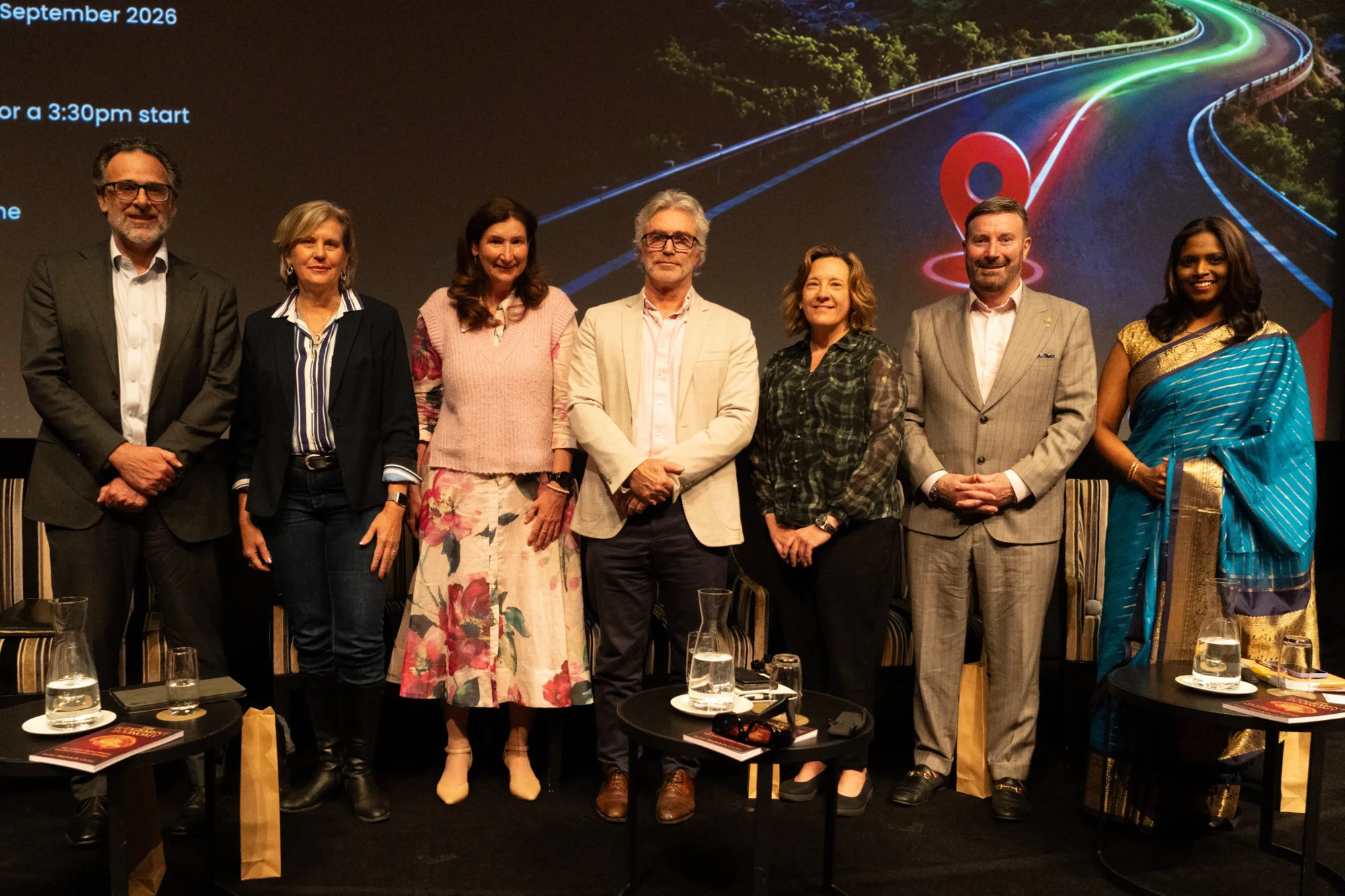
The five panellists standing on stage with Rodney Beach and Dr. CeeVee after the session
The panel, with authors Rodney Beach and Dr. CeeVee (right), after the session.Melbourne CBD · 18.09.2026
What the room kept coming back to

Five threads we’re still pulling on.

From the classroom to the battlefield to your own desk. Reconstructed from our notes and the conversations afterwards, with our own take layered on top. Read slowly. Each one ends with a question for you.

On the next generation

The next generation has the qualifications. What about judgement?

Picture a Year 12 student in 2026. Any essay, any assignment, any take-home exam can be produced in under a minute, polished and plausible. The certificate at the end of that education proves a little less every year. Gregor Kennedy, Deputy Vice-Chancellor at the University of Melbourne, pointed the room at the one thing AI can’t do on a student’s behalf: the learning itself.

The focus will increasingly be on the development of human expertise, and that will be about focusing much more on the processes associated with human learning. At the moment we tend to focus a lot on the outcome, about whether or not someone’s got the certificate.
Gregor Kennedy · Deputy Vice-Chancellor, University of Melbourne
What we assess nowWhat we’ll have to assess
The finished essayThe drafts, dead ends and decisions behind it
The exam scoreThe reasoning, defended out loud
The certificateEvidence of expertise growing over time
Completions and seat timePerformance in situations that feel real

There is a harder problem underneath. In the foyer afterwards, Michelle Parry-Slater asked the question nobody had a tidy answer for. This cohort lost years of ordinary social learning to COVID. Judgement is learned socially: by reading a room, being corrected, watching how others decide.

How can they have judgement when they don’t really have the social skills?
Michelle Parry-Slater · overheard in the foyer

For employers, this lands at the front door around 2030. Graduates will arrive with credentials that tell you less than they ever have. Building judgement stops being something universities hand over and becomes L&D’s job from day one.

Sit with this

If a degree can no longer prove what a graduate can do, what will your onboarding need to prove?
On expertise

The missing rungs.

Experts often know something is wrong before they can say why. That instinct is built over years of repetitions: the junior tasks, the mistakes a mentor caught, the hours spent watching someone better than you do the job. Those junior tasks are exactly what AI is absorbing first. The graduate analyst’s first model. The junior designer’s first draft. The research memo nobody reads twice. One panellist put the problem plainly.

I just get a sense that something isn’t quite right… I might not even be able to put my finger on it. If I’ve never been through any sort of apprenticeship, mentoring, development with a guide, how am I to develop that expertise?
From the panel

If we automate the bottom of the ladder, we have to rebuild the climb on purpose: simulated reps, scenario practice, structured mentoring, honest feedback. Otherwise, ten years from now, organisations will be full of senior people approving AI output and very few who can tell when it’s wrong.

Sit with this

If AI does the junior work, where will your juniors get their reps?

On life and death

Should a machine ever make the call?

Defence carried the heaviest version of the afternoon’s question. In a bank, a bad AI decision costs money or reputation. In uniform, it can cost lives. Sensors now see more than any analyst can, and decision windows that used to be measured in minutes are shrinking to seconds. The pressure to let the machine decide is real, and it is only going to grow.

Here is where we landed after the session. The speed of the machine can never become the excuse for removing the human. Accountability for a life-and-death call cannot be handed to an algorithm. But a human in the loop is only a safeguard if that human has the judgement to use it: under pressure, in seconds, with incomplete information. COL Karina Jones was clear that nobody gets there through a single course.

It’s ongoing conditioning and development that you will not just experience in a training institution but also in your units and throughout your career.
COL Karina Jones · Director, Army Training Systems & Education

You don’t need to wear a uniform for this to apply. A credit decision. A clinical triage call. A safety stop on a mine site at 3am. Every organisation has moments where “the system said so” is not good enough. Step through the ladder below and decide where your decisions sit.

Sit with this

Which rung does your most consequential decision sit on today? Where will it be in three years, and who will have decided that?

On speed

The speed paradox.

AI was supposed to give us time back. Ask anyone in that theatre how that’s going. Every tool that saves an hour seems to create two more hours of prompting, checking, reviewing and catching up. One panellist gave it a name: the speed paradox.

When people try to match the pace of the machine, the first thing to go is the slow, deliberate thinking that judgement depends on. Decisions get made at the speed of the tool instead of the speed of understanding. The organisations that win this decade won’t be the fastest. They’ll be the ones whose people know when to slow down.

Sit with this

Where is your team racing the machine instead of steering it?

On being human

Keep the human in the room.

Every thread ended in the same place. Emma Weber took it furthest, into belief, meaning and what it takes to bring your whole self to work alongside AI. Brad Coumbe, who leads learning at CommBank, walked out holding on to her point that it is passionate people who make AI into what we want it to be. In the foyer afterwards, Rod put the whole afternoon into a single line.

Intelligence can solve a problem, but wisdom knows which problem to solve.
Rodney Beach · Global President, Liberate
Sit with this

Who in your organisation decides which problems are worth solving?

How are we gonna get the ego state that we have at CEO level into an eco state?
Michelle Parry-Slater · overheard in the foyer
The book launch

The sari story.

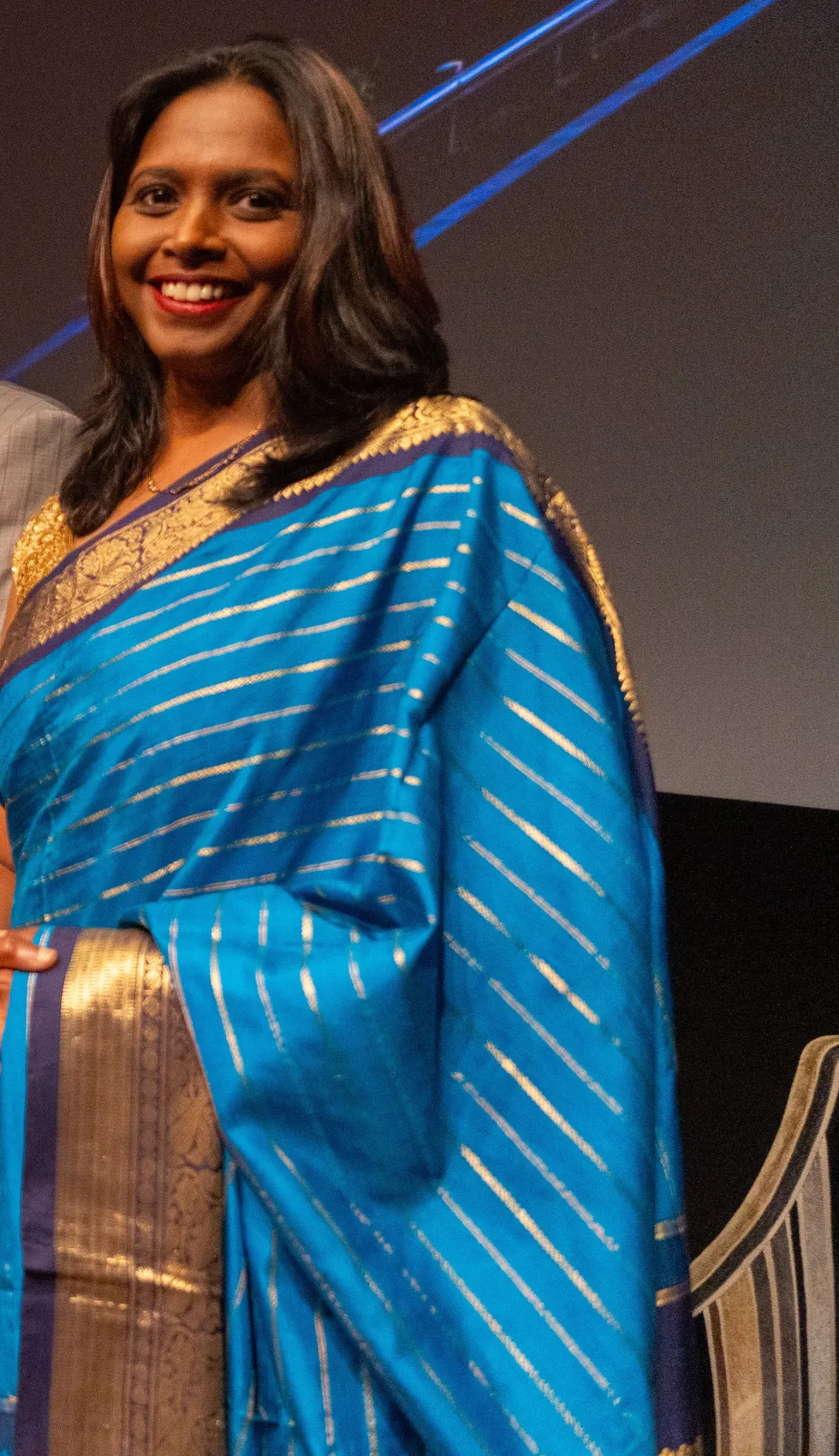
Dr. CeeVee opened the launch of The Judgement Economy with the sari she was wearing. It came from Kanchipuram in Tamil Nadu, a hand-loom district whose silk designs drew European and Persian traders for centuries. The knowledge of how to make them was passed down inside families, from one generation to the next.

In the 1990s the looms were modernised. Power looms and computer-aided design turned a month of work into days. The market flooded with tens of thousands of new designs, and many of the artisans who carried that knowledge lost their livelihoods and left for the city in search of new skills.

Nobody in the theatre missed the parallel. The machines didn’t make the knowledge worthless. They made it cheap. What was lost was the judgement of the people who knew which patterns mattered, and why.

Dr. CeeVee on stage in her blue and gold Kanchipuram silk sari
Dr. CeeVee, in the Kanchipuram silk she spoke about.
Then Rod put the glasses on

Knowledge, delivered to the eye.

Rodney Beach followed with a pair of pre-release, AI-enabled smart glasses: a teleprompter, live cues, a nudge if he skipped a topic. His point was practical. If knowledge is going to reach people in the flow of work through devices like these, it first has to be broken into small, trustworthy “atomic” assets. And someone has to own whether those assets are true.

The idea that travelled

The role nobody has yet.

Two leaders, two separate conversations in the foyer, and both landed on the same idea from the book: someone has to own the integrity of what an organisation knows.

The role of the Knowledge Integrity Officer… I think it is something that becomes part of the role that we have. So a skill set or a capability that we bring into our role.
Brad CoumbeExecutive Manager, Learning, CommBank
To come up with a solution to a business problem, you cannot be looking at one single domain and say, well, this is just about people, this is about technology.
Greg WoulfeFounder and Chief Everything Officer, Future Capable

Brad’s view is that this sits naturally with L&D, because L&D already does the hard part: getting SMEs, IT, HR and the business into one conversation, and solving the problem instead of just building the course.

Your turn

Where would you draw the line?

Eight everyday pieces of L&D work. For each one, decide: can a machine do it well today, or does it need human judgement? There are no wrong answers, only revealing ones.

MachineJudgement
0 of 8 decided
After the panel

Overheard in the foyer.

When the panel wrapped, the conversation moved to the foyer, and this time the camera came too. Unscripted takes from the people who were in the room. Captions are on.

In a world that was all knowledge, and now with the importance of judgement, I see that being a critical capability that we need going forward.Brad Coumbe · Executive Manager, Learning, CommBank
You cannot remove the human from the use of AI at all.Emma McDonald · Learning Design Innovation Manager, Coles Group
What will get us through is community. It’s learning from each other, and that’s uniquely human.Michelle Parry-Slater · Director, Learning & Organisation Development, Learning Uncut
If you’re not out there and you’re not paddling, then you’re gonna miss the wave.Greg Woulfe · Founder and Chief Everything Officer, Future Capable
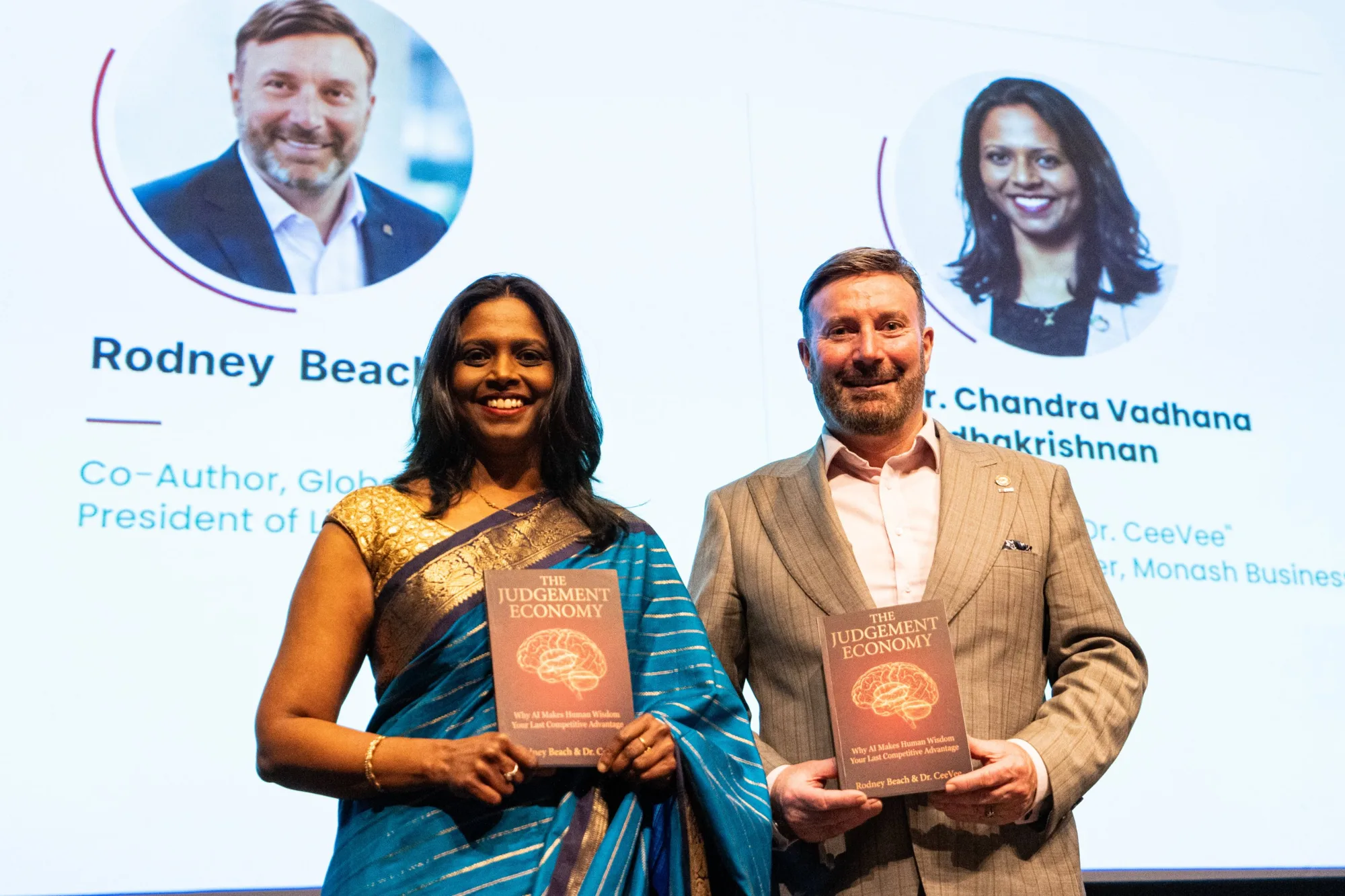
Dr. CeeVee and Rodney Beach on stage, each holding a copy of The Judgement Economy
Dr. CeeVee and Rodney Beach at the launch.
Launched on the night

The Judgement Economy.

Why AI makes human wisdom your last competitive advantage.

By Rodney Beach, Global President of Liberate, and Dr. Chandra Vadhana Radhakrishnan (Dr. CeeVee), Senior Lecturer at Monash Business School.

  1. I
    The Collapse. What is already breaking in today’s organisations.
  2. II
    The Intelligence Transition. What is replacing the Knowledge Age.
  3. III
    The Integrity Age. Where defensible advantage gets built.
  4. IV
    The Human Renaissance. Why the ending is optimistic.
For the people who missed it

Get a free copy, signed by the author.

We’ve set aside a limited number of signed copies for leaders working through AI change in their organisations. No purchase needed. Follow the link, sign up, and tell us where to send it.

Claim your signed copy

Next time, be in the room.

Seats at our Future of L&D conversations go first to the people who ask. Reply to the email this page arrived in and we’ll put your name down for the next one. And if one of these threads is already playing out in your team, we’d be glad to talk it through over a coffee.

Liberate Liberate · liberateglobal.com

Clip